
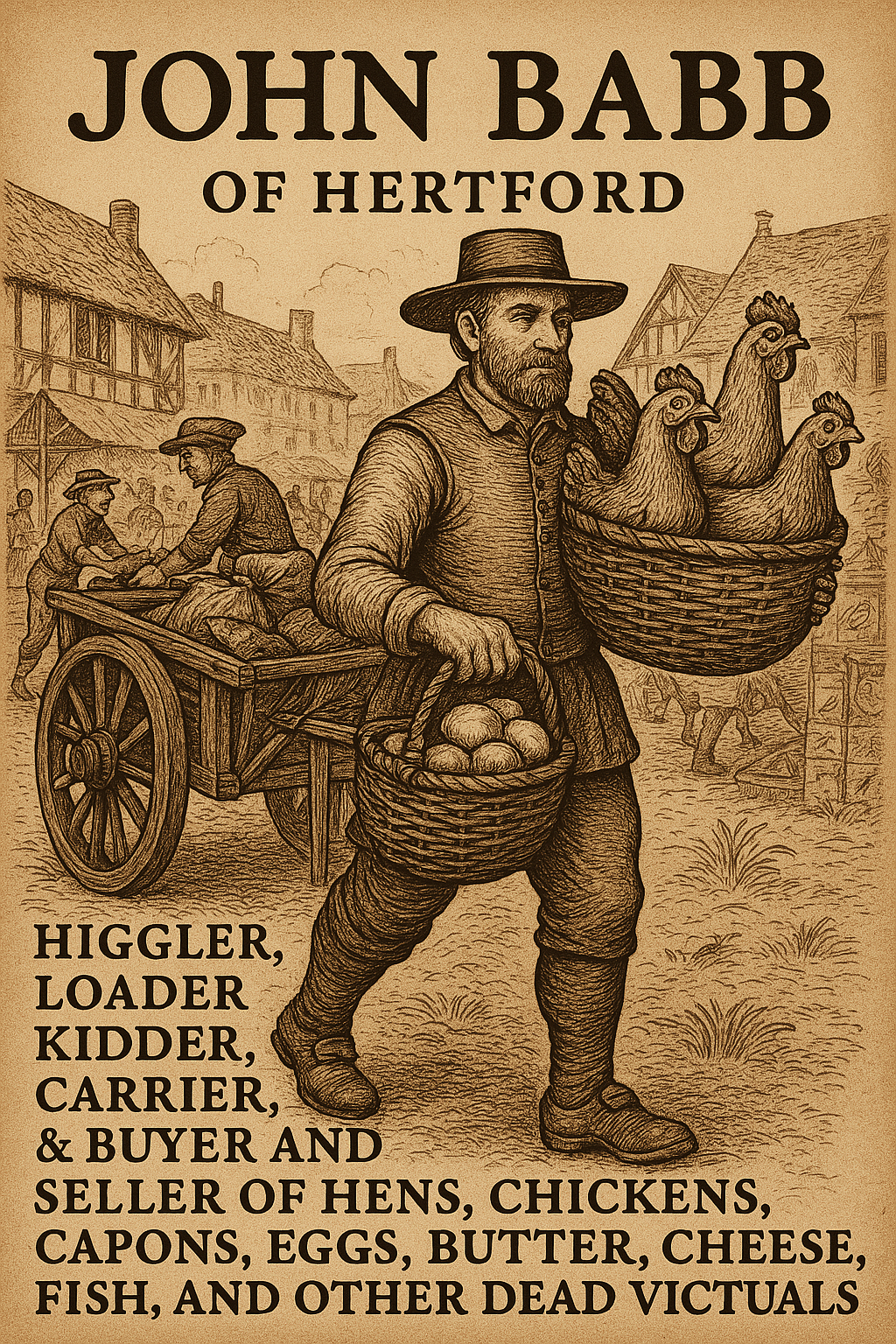
I’ve always been fascinated by the ways our ancestors organized their lives and built their economic world. While sifting through historical records from Hertford, Hertfordshire [pronounced Heart-ford-shire] I came upon a genealogical document from 1683, that tells us a little about one John Babb(s). John is currently part of a tree fragment that is named Hertfordshire Pedigree (Hertford 1683). His record may be brief, but the details behind his licensed occupations reveal a microcosm of early entrepreneurial versatility in 17th-century England.

A Modern English Translation
Here’s the modern rendering of the record:
Merchant License: “John Babb, of Hertford, is hereby licensed to act as a common higgler, loader kidder, carrier, and as a buyer and seller of hens, chickens, capons [rooster that’s been castrated before reaching maturity], eggs, butter, cheese, fish, and other perishable foodstuffs throughout the kingdom of England. Note that this license specifically excludes the trade of pheasants, hares, and partridges.”
This translation not only reveals the bare facts of his family history but also details the trades he was permitted to practice, giving us a glimpse into the economic landscape of the time.
Dissecting the Occupations
John Babb wasn’t a one-trick pony; his license allowed him to function in several capacities. Let’s break down each role and explore how profitable these endeavors might have been in late‑17th‑century Hertford.
1. Higgler
What It Was: A higgler was essentially a traveling merchant who moved from one town to another, buying and selling various small goods. This role depended on keen negotiation skills and a deep understanding of regional market prices.
Profitability: Higglers often earned moderate profits. They had to contend with slim margins—making every purchase and sale count—and the inherent risks of travel (like theft or spoilage). Success depended on spotting bargains and transporting goods efficiently between markets.
2. Loader Kidder
What It Was: The term “loader kidder” hints at a dual role. On one hand, the loader was in charge of the physical labor of moving goods onto carts or wagons. On the other, the “kidder” element suggests an involvement in small-scale trade and market negotiation. Essentially, it was a hybrid occupation that mixed physical labor with modest trading activities.
Profitability: This role was probably modestly profitable. While the labor was steady—critical for ensuring goods reached markets on time—the combined trade element helped supplement a laborer’s earnings. However, the margins tended to be low, with success tightly interwoven with efficiency and volume.
3. Carrier
What It Was: The carrier’s job involved transporting goods between locations. In an era when England’s roadways were often rough and travel was slow, reliable carriers were vital in connecting producers with urban markets.
Profitability: For those operating on busy trade routes and with access to quality transportation (sturdy carts and dependable horses), the carrier’s role could be quite profitable. Yet, this role was not without its risks—loss, theft, and damage could quickly cut into profits.
4. Buyer and Seller of Foodstuffs
What It Was: This role was a direct form of trade focused on perishable food items: live poultry (hens, chickens, capons), eggs, butter, cheese, and fish. Merchants like John Babb would have sourced these goods from local producers and sold them at burgeoning market centers or fairs.
Profitability: The trade in perishable goods could be lucrative. With constant demand for fresh foods, a well-managed trade could yield healthy income. But there was little room for error—the quick perishability meant that effective stock management and rapid turnover were essential. The trader’s ability to minimize spoilage while maximizing sales determined success.
Why the Exclusion of Pheasants, Hares, and Partridges?
A particularly intriguing detail in the license was the explicit exclusion of pheasants, hares, and partridges from the list of tradable items. In 17th‑century England, these species were considered high‐value game animals, reserved for the nobility and royal households. Strict game laws and hunting privileges meant that only the upper echelons of society were allowed to trade, hunt, or even possess these prized animals. This deliberate restriction reinforced the social hierarchy, ensuring that common merchants—like John Babb—remained within the realm of everyday provisions, while luxury or specialty items were kept out of their economic reach. In addition, these exclusions helped conserve wildlife populations and maintain the exclusive recreational privileges of the aristocracy.
Reflections on an Early Entrepreneurial Spirit
John Babb’s diversified trade license is a testament to early market versatility. By operating as a higgler, loader kidder, carrier, and food trader, he exemplified the entrepreneurial spirit that many of today’s small business owners might recognize in their own efforts to diversify income streams. In an age when market networks were in their infancy, this mix of roles allowed traders to buffer against seasonal fluctuations and unpredictable market conditions.
The careful delineation of allowed and excluded trades—such as the barred game animals—also speaks volumes about the economic and social structures of the time. These regulations underscored a society where commerce and class were inextricably linked, laying the groundwork for evolving market economies over the subsequent centuries.
Keep exploring the past—because every old document has a story to tell!
Source Document: Hertfordshire County records v. 3
Never miss a post! Subscribe for free today!