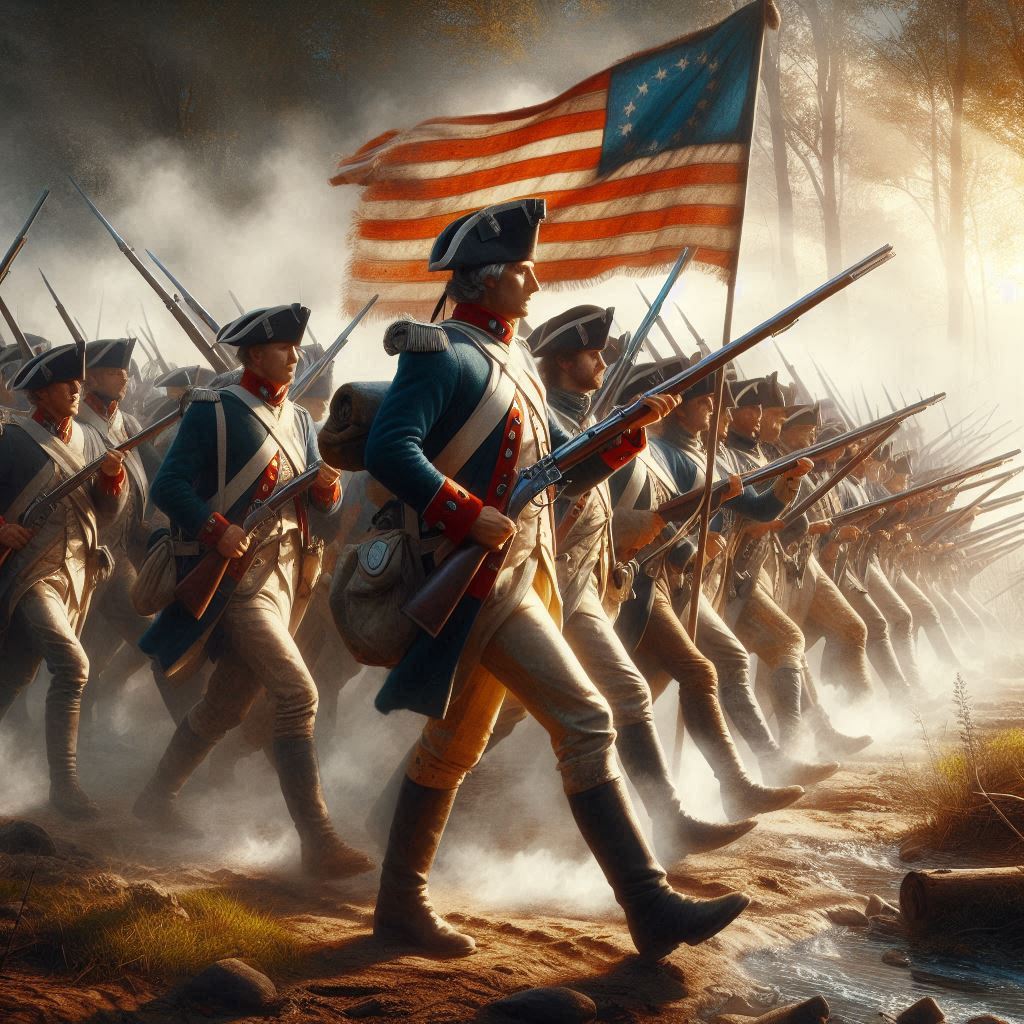
The most incredible little collection of records surfaced during this quest, the likes of which I have never seen. Before this series we knew nothing about Mercer’s life after Winchester, VA. But I’ve come to find out the the most thrilling parts of his life lay ahead of him as he moved to South Carolina.
First, we find Mercer is listed as a Private, serving in the American Revolution. However, no such records exist of him on Fold3, which documents military history. There may be records somewhere, but I’ve been unable to locate them as of publication date. So, take this information with a grain of salt, until records arrive on the scene to support the claim.
It was not common for Quakers to fight during the American Revolution. Quakers, also known as the Religious Society of Friends, are known for their strong commitment to pacifism and nonviolence, which is a core tenet of their faith12. Most Quakers refused to support any military actions and did not participate in the fighting13.
However, there were some Quakers who did participate in the conflict in various ways, such as through nonviolent actions like embargoes and economic protests14. Those who chose to fight or support the war effort often faced disciplinary actions from their religious community1.

Summer, George Leland: Internet Archive, p. 9
The dates of his alleged service are unknown. However, we know that he was firmly planted in Newberry Co by 1781, when he brought an amazing number of resources to bear to help the American Revolutionary war effort. He clearly supported the war effort through a series of actions that are laid out in an Audit of his accounts.
The Audit dates are 1781-1783 and lay out a clear commitment to the cause of the Continental Army and Militia. After the war ended, people were eligible to submit receipts for their service to the military during the war.
This document, submitted in 1786, is from after the war. Some of the receipts are quite touching. In all, it was worth 21 Pounds, 8 Shillings and 3 Pence (no relation to Mike) and he was reimbursed by the State of South Carolina.
His Contributions
Items from the receipts point out:
Rations for 13 Men of forage and 14 horses- 26 Jul 1781
<illegible>
Provisions for 12 Men on Command – 28 Aug 1781
Forage and rations for 13 Men – 12 Oct 1781
8 Bushels of Corn, 90 Sheaves of fodder [livestock feed] & 20 Sheaves of Oats. Likewise, victuals for 50 men one meal for party on Col. Brandons Regiment – 8 Jan 1782
100 weight of Pork (112 Pounds American) for the public – 14 Jan 1782
Rations and forage for 19 men and 20 horses on their march to the block house – 20 Jun 1782
Forage for 10 horses and Rations for 10 men – 29 Jun 1782
40 rations and forage for 40 horses on public service – 30 Jul 1782
Rations for 13 men – 30 Jul 1782
Rations and forage for 19 men and 18 horses – 9 Aug 1782
40 rations and forage for 40 men, them on horse – 21st Aug 1782
____ of Oats for the use of the public – 23 Oct 1782
Forage for 17 horses – 3 Sep 1782
Rations and forage for 24 men & horses – 12 Oct 1782
3 Bushels and a peck of Corn and fodder [livestock feed] one night for 27 horses and 54 rations and a quart of whiskey for a detachment of men out after Cunningham and his party thee – 12 Feb 1783
Forage and rations for 13 men and horses – 2 Mar 1783
While some are illegible, I count 280 men and 273 Horses, 112 pounds of Pork (149 men/1 day.), 12 bushels of Corn (660 men/1 day), 20 bushels of Oats (630 men/1day) and a Quart of Whiskey (well, you know that didn’t last through the night!)
So, his net aid to the Military was the equivalent to 1992 meals to men & their horses.
This is stunning! For a person, who by religion is a pacifist, to have given so much aid to the American forces shows such a deep commitment to the cause that it is almost incomprehensible. He clearly was a man of means in order to be able to not starve while giving such an immense amount of aid to the Continental Army and Militias.
A biographical sketch from his time in the Legislature adds that in 1788 he served as a magistrate for Newberry County.

So, without further delay, here is the audit of Mercer Babb’s records from the last 3 years of the American Revolution. It is 10 pages in length, so make sure to scroll through all of it.
I had no idea as I stood on his doorstep last month, knocking to see if anyone was at home, that I was knocking on the door of an American Patriot!
There appears to be no extant grave marker for Mercer or his wife Rhoda, so just as his father before him, he likely had a simple marker that was lost to time. He is probably buried in the Bush River Quaker Cemetery (aka Bush River Meetinghouse Cemetery).

Blanche (Mercer) Babb
Some of you will recall the rededication of Blanche (Mercer) Babb, who is another Quaker, American Patriot who took a similar approach to giving aid to the Continental Army. She married Mercer’s brother Thomas. Mercer’s mother was also Margaret Mercer, which is the reason for the name becoming a given name. We haven’t sorted out the connections of the Mercer (surname) families to know how they are all related.

Joseph Babb (1-2-2-3)
Previously, I mentioned that Mercer had moved to South Carolina with his cousin Joseph Babb. Well guess what? He also is a Quaker, American Patriot! And, his wife, Mary McCool Babb, is also a Quaker, American Patriot! Their graves were just rededicated last year.


So, there you have it. A brand-new American Patriot, the real kind! With kin like this, it is no wonder that he bore such a determination to do the right thing! While we know much more, we still know too little about him.
Did his church disagree with his actions? Records do not exist to tell that story. But it seems he said, “to heck with it!” After all, he had already been disowned once before. After all, he was a Babb!
What a fascinating life he had! But what else could you expect from this Star-Spangled family?