
Tracing the Babb Family’s Legendary Roots to the First Kings of Denmark
Every so often, genealogy hands us a story so old, so mythic, that it feels less like research and more like opening a door into the deep imagination of our ancestors. Today’s chapter takes us far beyond the Isles of Shoals, beyond England, beyond even the earliest written records. It carries us into the world of longhouses, mead-halls, and oral tradition—into the realm of Skjöldr, the legendary founder of the Danish royal line and, remarkably, the 49th great-grandfather of Bathsheba Hussey, wife of Thomas Babb, second son of Phillip Babb of the Isles of Shoals. Skjöldr is the earliest known ancestor in Bathsheba’s amazing lineage.
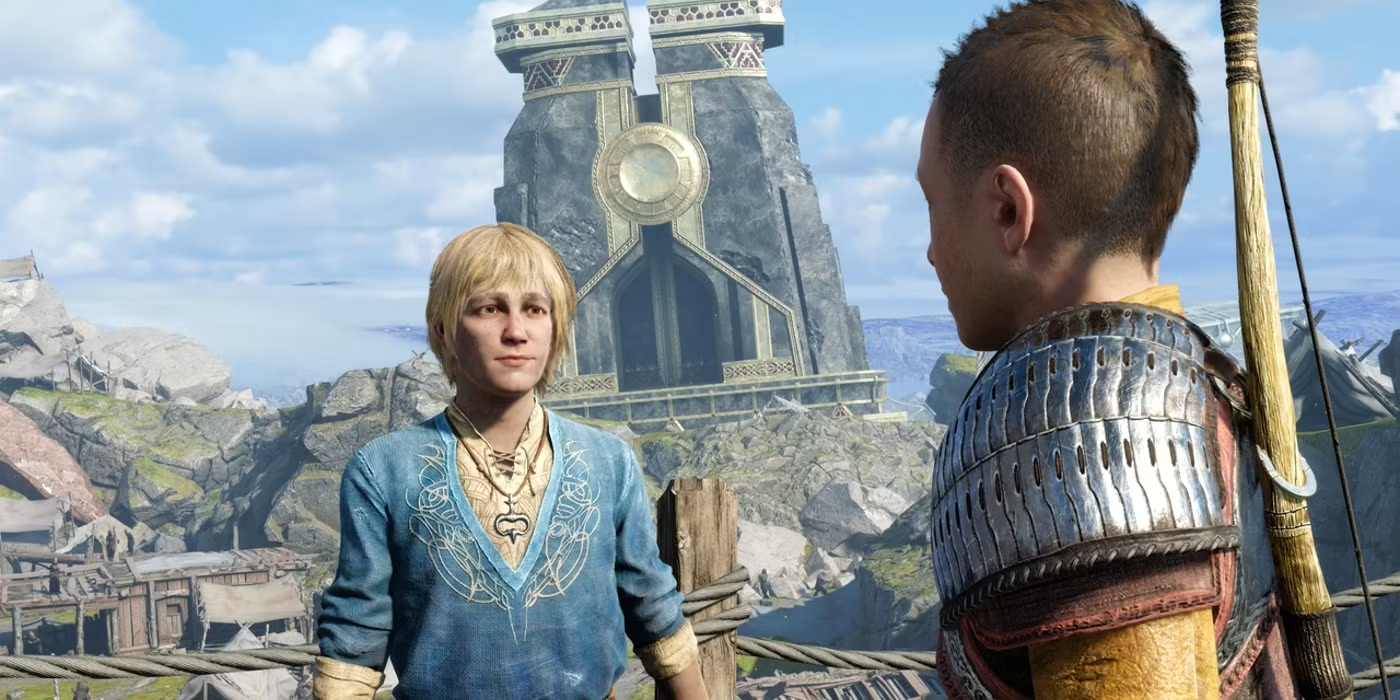
Cover Image: Skjöldr as pictures in the video game “God of War Ragnarok.”
Bathsheba’s lineage, already rich with early New England history, reaches back into the mythic north—into a time when kings were born in drifting boats and returned to the sea in shining funerary ships.
A King Born of the Waves
According to the Old English epic Beowulf, Skjöldr—called Scyld Scefing—arrived as a mysterious child, discovered alone in a boat, a sheaf of grain at his head. Frail at first, he grew into a formidable warrior-king whose rule united border tribes and commanded tribute from seafaring peoples. His story is one of transformation: from foundling to founder, from castaway to king.
This maritime imagery resonates unexpectedly with the Babbs of the Isles of Shoals, whose lives were shaped by the sea. The echo across centuries is almost poetic—our ancestors, too, were people of the water, carving out their lives on rocky shores and unpredictable tides.

The Shield of Denmark
In Norse tradition, Skjöldr’s name means “shield”, and he is remembered as the progenitor of the Skjöldung (or Scylding) dynasty—the earliest royal house of Denmark. Medieval sources such as the Prose Edda, Ynglinga Saga, and Gesta Danorum place him among the first kings after Odin himself, establishing order in a world still half wild and half divine.
Whether Skjöldr was a historical chieftain later mythologized or a purely legendary figure, his presence in the genealogical record speaks to the way medieval families—and later, early modern ones—wove identity from both memory and myth. For Bathsheba Hussey’s line, he stands as a symbolic ancestor: a reminder that family history is not only about documents and dates, but about the stories people told to explain who they were.
From Danish Kings to New England Shores
How does a Danish shield-king become an ancestor to a woman living in colonial New Hampshire?
The answer lies in the long, tangled web of medieval European descent. Over centuries, noble and royal lines intermarried, their descendants eventually filtering into the families who would migrate to England and, later, to the New World. By the time Bathsheba Hussey married Thomas Babb, the second son of Phillip Babb of the Isles of Shoals, Skjöldr’s story had traveled nearly three millennia—crossing cultures, languages, and oceans.
For the Babbs, whose American story begins with a fisherman on a rugged archipelago, this connection adds a surprising new dimension. It reminds us that ancestry is not linear but layered: humble and grand, documented and legendary, earthly and mythic.
Why These Legends Matter
Some might ask: What place does a legendary Danish king have in a modern family history project?
The answer is simple. Genealogy is not only the pursuit of facts—it is the pursuit of meaning.
Skjöldr’s story, preserved across sagas and epics, offers:
- A cultural inheritance, connecting our line to the earliest Germanic storytelling traditions.
- A symbolic origin, reflecting themes of resilience, leadership, and maritime identity.
- A reminder of continuity, showing how stories survive long after kingdoms fade.
For a family like the Babbs—whose history is deeply tied to the sea, to survival, and to the shaping of community—Skjöldr feels less like a distant myth and more like an ancestral archetype.
A Legacy Carried Forward
Bathsheba Hussey, through whom this lineage flows, stands at a crossroads of history: between the ancient and the colonial, between the legendary and the lived. Her marriage to Thomas Babb binds the Babb family to a lineage that stretches back to the earliest kings of Denmark and the poetic imagination of the medieval world.
Skjöldr’s tale is not meant to replace the documented history of the Babbs—it enriches it. It reminds us that our ancestors lived in a world where myth and memory intertwined, where identity was shaped as much by story as by fact.
And now, that story becomes part of ours.
2 responses to “Skjöldr: The Shield-King at the Dawn of Our Lineage”
Daniel,
Again you have shared a fascinating aspect of my husband’s ancestors! Thank you for sharing this. I will share this with our family, as we are in Thomas Babb and Bathsheba Hussey’s lineage. Your genealogical research into the Babb’s lineage is so appreciated!
Thanks, Again,
Karen Hargus
Fascinating tale. Much like Moses.