
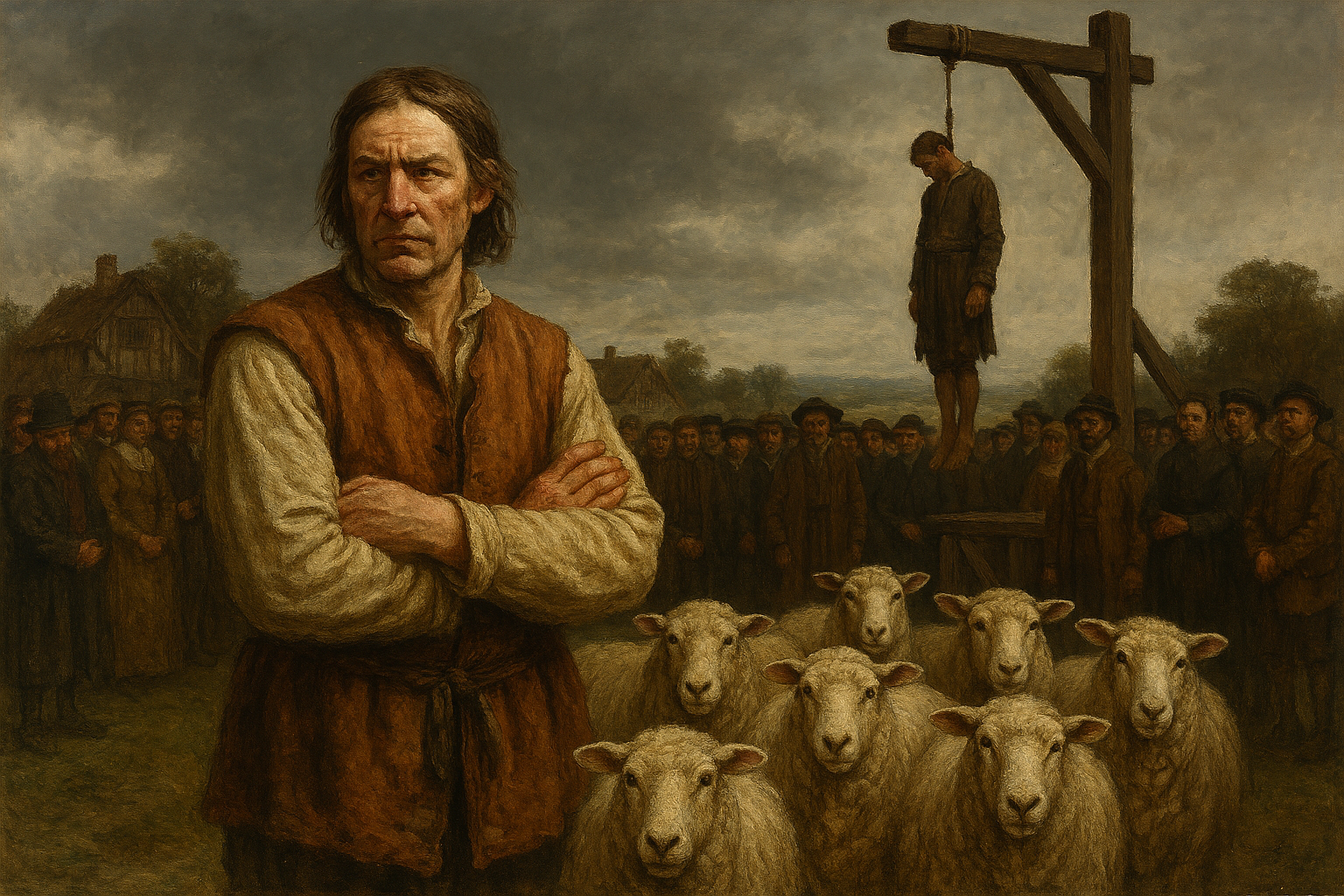
1: The Shearman’s Loss
Bramley, Surrey – October 6, 1578
The morning mist hung low over the fields as John Babbe, a shearman of Bramley, stepped into his pasture. Ten sheep—gone. No broken fence, no sign of predators. Just hoofprints vanishing into the woods.
John’s livelihood depended on those sheep. Each one represented hours of labor, a season’s worth of wool, and the fragile security of a tradesman’s life. He suspected theft, and soon the whispers in the village confirmed it: Thomas Hedger, a butcher from Hascombe, and William Kerrey, a husbandman from Cranleigh, had been seen near Bramley days before.
John reported the theft. His name was entered into the court rolls. Months passed, and the case grew—more victims, more sheep, more towns. The thieves had left a trail from Shalford to Godalming, from Enton to Smithwood.
2: The Trial and Sentence
Guildford Sessions – June 30, 1579
The courtroom was packed. The Justices of the Peace—Sir William Moor, Sir Thomas Brown, Edmund Slyfield, and Lawrence Stoughton—presided over the Guildford Assizes. The Grand Jury, twenty strong, heard the charges.
Thomas Hedger and William Kerrey stood accused of grand larceny—eleven counts of theft of 69 sheep across Surrey. Among the victims: Henry Balchyn, Francis Denyer, John Smither, Nicholas Elyott, William Wheeler, John Bisbridge, John Tycknor, Hugh Mellershe, and John Babbe, whose ten sheep had vanished from Bramley.
The evidence was overwhelming. Witnesses spoke. The stolen sheep had been sold, slaughtered, or hidden. Hedger, the ringleader, was found guilty on all counts. The sentence: death by hanging.
Kerrey, though guilty, was allowed clergy—a legal loophole for first-time offenders who could read a passage from the Bible. He escaped the gallows.
Thomas Preist and John Waters, named as accessories in one theft, were acquitted.
3: The Gallows at Guildford
Guildford – July 1579
The gallows stood stark against the summer sky, a grim silhouette on the edge of town. Among the crowd gathered to witness the execution was John Babbe, his wool-stained hands clenched at his sides.
He had come not for vengeance, but for justice. The theft had wounded more than his purse—it had shaken the trust of a community, the dignity of honest labor. Hedger had preyed on men like him, tradesmen and husbandmen who lived by the rhythm of the land.
As Thomas Hedger was led to the scaffold, his eyes scanned the crowd. He saw no friends, no allies. Only the faces of those he had wronged.
The sheriff read the sentence. Hedger made no plea for mercy. The noose was placed. The trapdoor fell.
John Babbe did not flinch. He watched, silently, as the law took its course. Then he turned and walked back toward Bramley, the weight of justice heavy, but the burden of injustice lifted.
Notes & Analysis
John Babbe of Bramley was discovered as a result of this criminal trial. Prior to this, no early presence in Surrey (an outlying county southeast of London) has been detected. We know that he would have been at least 21 to be recognized as the owner of the missing sheep. So, he was born prior to 1558. Surrey has yet to be canvassed for early records and there is nothing more to report about him at this time. He is currently placed in Surrey Pedigree (Bramley 1578).
In the same Assizes records we find a William Babb(e) who performed service as a charge of the court for a position known as a Bailee. In this context a Bailee likely held property on behalf of another (The Bailor): This could include goods, livestock, money, or even documents during their Assizes trials.
Bailor ≠ Court Bail Provider
Don’t fall into this trap. The position sounds similar to our modern terminology, but they aren’t the same thing.

Shearman or Shepherd
I have not found other shearman or shepherds in our tree, despite the Y-DNA lineage known as “The Good Shepherds of Hatherleigh“. The name is derived from a common trade of the town of Hatherleigh and does not represent an exact match to a particular person or family. So, please refrain from drawing any conclusions as to a relationship until more information comes to light.
The Trees
At this time, there is only the single record that lists a residence for either man. It is for John and it is Bramley. All of the other records only contain the location that the Assizes were held. Not where the people came from that held them.