
The story of the Babb family of Macclesfield, Cheshire England & Paterson, Passaic, NJ
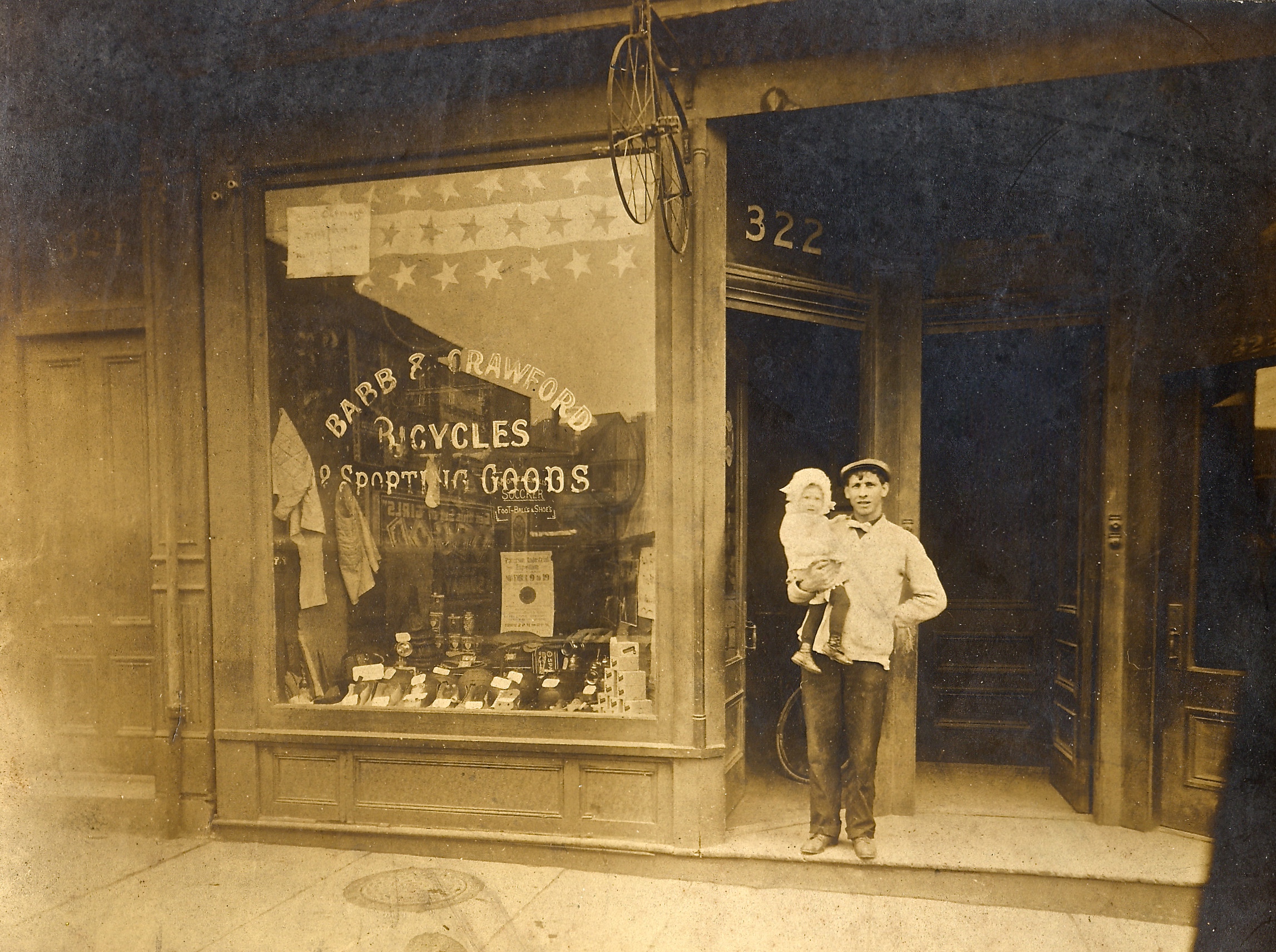
Cover Image: William Walter Babb, holding his 1st cousin, Edith Margaret Babb the daughter of his uncle Walter Babb, circa 1910.
1. Introduction: A Family in Motion
In the heart of early 20th-century Paterson, New Jersey, a storefront at 322 Market Street buzzed with the energy of innovation, sport, and family enterprise. Behind its glass windows, bicycles gleamed—lightweight marvels built for speed and endurance. But this wasn’t just a shop. It was the beating heart of a family whose passion for cycling shaped their legacy and their city.


Meet Walter Babb (left) and Alexander Mitchell Crawford (right), circa 1893. Their legacy began on the racecourse, in the early 1890s as they were making their rounds through the competitive cycling circuit. The above images are the earliest known for either man.
They are clearly a collaborative effort as they wear identical uniforms, and each have a medal hanging from their jerseys. They even have identical bicycles. This looks to commemorate their first win!
Kubey, the photographer of the cabinet card sold off his studio circa 1895 after first jettisoning Zabriskie. So, these are from the first half of the 1890s. Let’s say they were 18 at the time, which would place this as circa 1893. The next image was taken in that timeframe between the exit of Zabriskie and the sale to Heinrich, circa 1894-5.

We come next to a similar image of Walter that was taken by the successor, Heinrich, at the same studio and address. No medals this time as they were no doubt too many to dawn.

The newspaper articles pick up about 1895 where they appear to be competitors and then by 1896 they joined forces as a formidable tandem cycling team as is shown in the image below.

In the photo above Walter, riding in the rear, and Alexander, steering from the front, became local legends—known for their speed, coordination, and competitive spirit. A rare photograph captures the duo in action, dressed in athletic gear and seated on a long-frame tandem bicycle, held steady by Walter’s older brother Thomas Babb, dressed in formal attire. It’s a moment that blends sport, family, and spectacle—a visual prologue to the business they would later build together.
Below you will find a number of newspapers mentions of the Babb-Crawford team from just a single summer season of 1896. Many more appear in the years to come.


1905, Walter Babb (R) with Alexander Mitchell Crawford (L)
By the 1910s, Walter had transitioned from champion cyclist to entrepreneur, founding Babb & Crawford Bicycles & Sporting Goods with his sister Selina Babb and her now husband Alexander Crawford. The store’s name reflected not just a partnership, but a shared history of athletic excellence and mutual trust.

This is the story of the Columbia Racer, a bicycle that captured the spirit of its time. It’s also the story of the Babb family—of innovation, resilience, and the quiet power of generational memory. Through photographs, advertisements, and genealogical records, we trace the arc of a family in motion.
2. The Columbia Racer: Lightweight Legend of 1914
In the spring of 1914, a striking bicycle appeared in the window of Babb & Crawford Bicycles & Sporting Goods in Paterson, New Jersey. It was the Columbia Racer, a sleek, featherweight machine that promised speed, strength, and modernity. A sign in the window declared its specs with pride:
“Columbia Racer Complete 19 lb 6 oz.”

This wasn’t just marketing—it was a technological boast. At a time when most bicycles weighed 25 to 30 pounds, the Columbia Racer’s sub-20 lb build placed it among the elite racing models of its day. Designed for road service and competitive use, it embodied the cutting edge of American bicycle engineering.
A matching advertisement from The Montclair Times, dated April 18, 1914, confirms the model’s release and its positioning in the market. The ad reads:
“Columbia Racer is as light as it is humanly possible to build a bicycle consistent with strength to meet the demands of road service.”
“It makes bicycling a great pleasure to ride a bicycle that is light and strong—and the Columbia Racer is.”

The Columbia Racer was produced by Pope Manufacturing, a pioneer in American bicycle design. By 1914, Pope had already established Columbia as a household name, and the Racer was its answer to the growing demand for high-performance machines. The $40–$60 price tag placed it within reach of serious cyclists, including Walter Babb, whose own racing pedigree made him the perfect ambassador for the model. Comparably priced items were one month of rent in an apartment, a Term at a Private College, a Gold Pocket Watch, a Men’s custom suit, a Singer sewing machine or a new typewriter. So, this wasn’t an out of reach item but certainly wasn’t cheap.
The storefront photo, paired with the newspaper ad, offers rare visual and textual confirmation of the Columbia Racer’s presence in Paterson. It also marks a moment when bicycles weren’t just tools—they were symbols of speed, freedom, and modern identity.
3. Babb & Crawford Sporting Goods: A Family Enterprise
At 322 Market Street in Paterson, New Jersey, the name Babb & Crawford stood for more than bicycles and sporting goods—it stood for family. The store was co-owned by Walter Babb, his sister Selina Babb, and her husband Alexander Mitchell Crawford, whose name appeared alongside hers on the storefront window. Together, they built a business that blended technical expertise, entrepreneurial spirit, and deep community roots.

Walter, a champion cyclist and seasoned mechanic, brought firsthand knowledge of racing and road conditions. Selina, the youngest of the Babb siblings, managed the business with precision and pride. Alexander, a Paterson native, completed the trio—his name a visible testament to the store’s partnership and permanence.
The sepia-toned photograph shown as the cover image for this article was taken in 1910 and captures this legacy in motion: William Walter Babb, youngest son of Walter and Selina’s eldest brother James Francis Babb Sr., stands in the doorway of the shop, holding his cousin Edith Margaret Babb, Walter’s daughter. Behind them, the window reads “Babb & Crawford Bicycles Sporting Goods”, and the address number “322” crowns the entrance. A bicycle wheel peeks from the shadows, anchoring the scene in its purpose.
This image isn’t just a family snapshot—it’s a generational handoff. It shows how the Babb family’s love for cycling wasn’t confined to races or retail—it was woven into everyday life. The store became a gathering place, a launchpad for innovation, and a symbol of the family’s enduring presence in Paterson.
🏍️ 4. From Pedals to Power: The Pope Motor Cycle Era
As the 1910s progressed, the world of personal transportation began to shift. Bicycles remained popular, but a new machine was capturing the imagination of riders and entrepreneurs alike: the motorized bicycle. At Babb & Crawford Sporting Goods, this evolution was embraced with characteristic foresight.

A later photograph shows Walter Babb seated proudly on a Pope motorized bicycle, parked in front of the same storefront at 322 Market Street. The signage now reads “POPE MOTOR CYCLES”, signaling the store’s expansion into motorized transport. The bike itself features balloon-style tires, a mounted engine, and a fuel tank—hallmarks of the transitional machines that bridged the gap between pedal-powered bicycles and full-fledged motorcycles.

This wasn’t just a business decision—it was a reflection of Walter’s lifelong passion for speed and innovation. As a former state champion cyclist, he understood the thrill of motion and the importance of adapting to new technologies. The Pope motor bicycle, likely dating from 1916 to 1919, represented the cutting edge of that transition.

By offering both racing bicycles and motorized models, Babb & Crawford positioned itself as a hub for Paterson’s evolving sporting culture. Whether a customer sought the featherweight agility of a Columbia Racer or the power of a Pope Motor Cycle [sic], they could find it under one roof—guided by a family whose love for wheels ran deep. By 1920 Alexander Crawford had moved on to public service and drifted away from the business. He had a growing family of 4 children and perhaps needed more income than the store could provide.

By 1928, Walter had taken up partnership with Raymond Smith and the store was rebranded Babb-Smith. They broadened their mission and started supporting local sports teams, such as the Babb-Smith Sapphires, a girls’ basketball team. It is at this time we see the first advertisements appear in the local newspapers.

The buildings at both 301 & 322 Market Street still stand, but have seriously deteriorated along with the neighborhood. I would NOT recommend visiting in person. Instead take a streetside view through your favorite mapping app.
5. Walter Babb: Champion Cyclist and Community Leader
Long before he became a shop owner, Walter Babb was known across New Jersey as a formidable amateur cyclist. Born in Macclesfield, England in 1875 to Thomas Babb and Ann Challinor, and brought to the United States at age five, Walter grew up in Paterson and quickly made his mark in the world of competitive cycling. He won state championships, raced in regional events, and became a respected figure in the Triangle Cycling Club, a local organization that fostered camaraderie and athletic excellence.

His obituary, published in The Morning Call on February 17, 1943, paints a portrait of a man whose life was defined by motion, dedication, and service. It notes his long illness, his age at death (67), and his deep ties to Paterson. He was a member of the Loyal Order of Moose, Lodge No. 553, where he served as Treasurer, and he remained active in civic life even as his racing days faded into memory.

Walter was survived by his wife Mary H. Jones, his daughter Edith Margaret Babb, and three sisters—including Selina Crawford, his business partner and co-founder of Babb & Crawford Sporting Goods. He was laid to rest in Laurel Grove Memorial Park, leaving behind not just a family, but a legacy of innovation, athleticism, and community engagement.

6. Legacy and Lineage: The Babb Family Story
The story of Babb & Crawford Sporting Goods is inseparable from the story of the Babb family itself. Through genealogical records, photographs, and personal memory, a clear lineage emerges—one rooted in innovation, resilience, and a shared love of cycling.

Walter Babb, born in 1875 to Thomas Babb and Ann Challinor, was the youngest son in a family that valued craftsmanship and community. His sister Selina Babb, born in 1878, married Alexander Mitchell Crawford, and together they co-founded the store that bore both their names. Their entrepreneurial spirit was matched by their commitment to family, as seen in the 1910 photograph of William Walter Babb—youngest son of Walter’s eldest brother James Francis Babb Sr.—holding Walter’s daughter Edith Margaret Babb in front of the shop.
This moment, frozen in sepia, is more than a family snapshot. It’s a symbol of generational continuity, of values passed down through bicycles, business, and bonds. The Babb family didn’t just sell sporting goods—they lived the culture they helped create.
7. Conclusion: Wheels That Carried a Legacy
The Columbia Racer may have weighed just 19 pounds and 6 ounces, but the legacy it carried was far heavier. It represented a moment in time when bicycles were more than transportation—they were identity, aspiration, and innovation. For the Babb family, cycling was a way of life, a business, and a bond that connected generations.

From Walter’s championship races to Selina’s co-ownership of the store, from William Walter’s quiet pride to Edith Margaret’s place in the family’s visual history, the story of Babb & Crawford Sporting Goods is a story of motion—forward, familial, and enduring.

The Tree
The Babb families of Paterson, Passaic, NJ descend from the lineage we refer to as DNA-09, The Potters of Staffordshire. While they came to the US from Macclesfield, Cheshire, England, their family hails from Staffordshire with the earlies known location in Cresswell, 1771.