
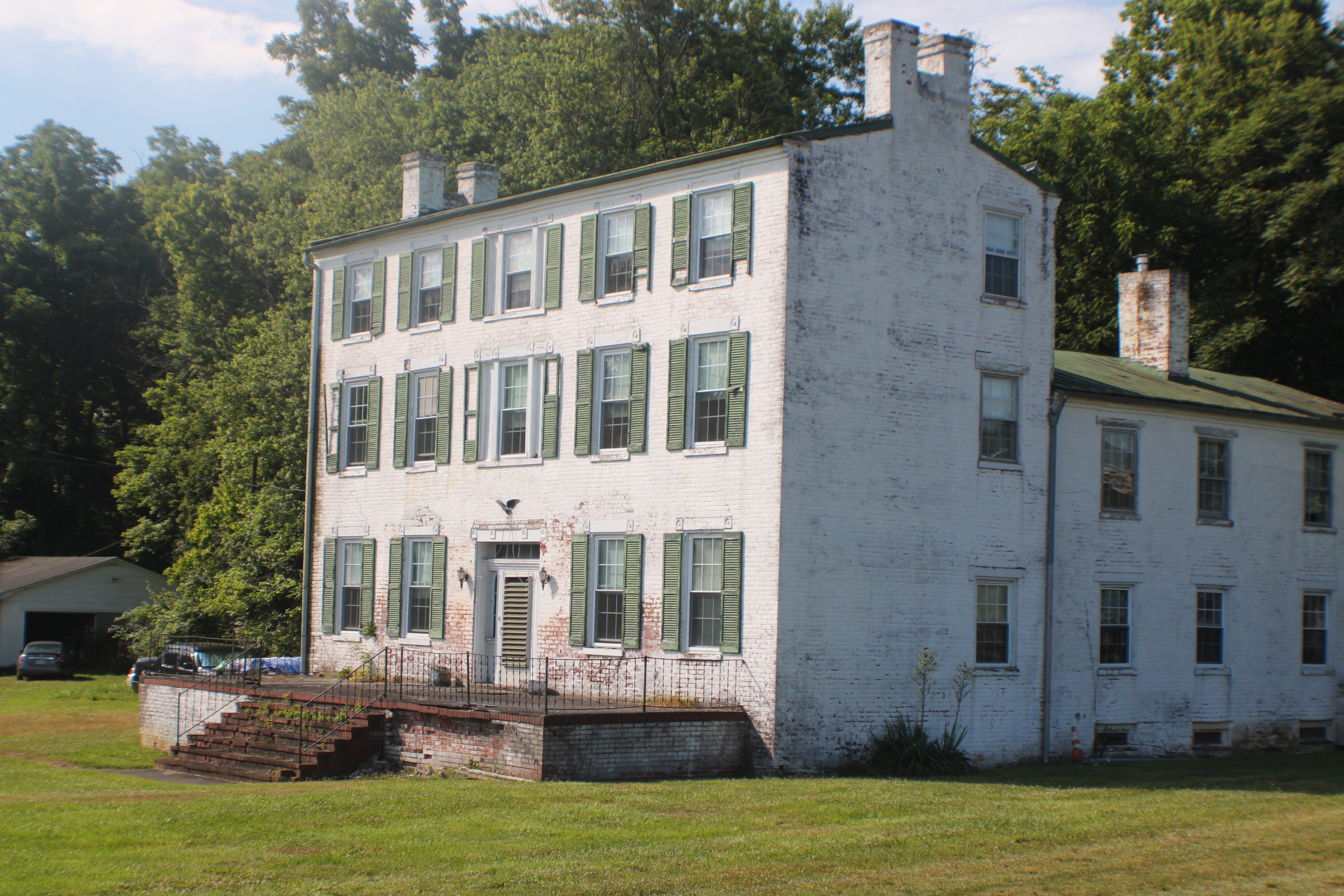
The first stop on our tour of Winchester, VA was the homestead of Mercer Babb (1-2-3-3). The home is not in good condition as of this writing and despite being set back a good distance from the Highway that it resides on, the land in front of it is home to a used car lot that destroys its stately presence (even though there is no curb on this asphalt road) and curbside appeal.

courtesy: Google Maps
The current owner stated that the home was used during the Civil War as a Hospital for a nearby fort on the other side of the highway.
Mercer’s history hasn’t been well defined in prior versions of Babb Unabridged or Babb Families of America. Perhaps this is in part due to the fact that he had no children.
We are going to change that trajectory today!
The Story of Mercer Babb: Part 1
It has always been assumed that Mercer was born after the marriage of his parents in 1737 and before 1746. New evidence throws water on that theory.

We know that Mercer’s father was in trouble with the Quakers for having married contrary to discipline. At the 5 May 1737 Monthly Meeting the following testimony given at the previous Monthly Meeting (MM) by Phillip Babb was read according to order:
“To the MM of Newark [Delaware] held at ye center the first of ye second month 1738, Whereas I was brought up and educated in the principles of truth as it is professed by us as a people, but for want of haveing a due regard to devine assistance have lett out my effections on a woman not of our Society and accomplished my marriage by the priest contrary to my parents advice thereby haveing given ocation for the way of truth to be evel spoken of-for which offence against God, and disobadience to my parent and offence agains I am sorrey, and desire that the Lord may forgive me-and that Friends may continue me under their care, and I hope to be more watchful for the futer as witness my hand.
Signed Phillip Babb”
This document becomes important in revealing a deeper story, because of a series of purchases that Mercer Babb made in 1748. Given historical timelines, Mercer would have taken on 520 acres of land at the tender age of 11, or possibly even younger. We clearly need to delve into this and get to the truth.

Simply put, Mercer would not have been able to legally sign the documents prior to the age of 21, which puts his date of birth before 1727.

Mercer’s father Philip was born in 1699 and would have been 38 years old at the time of the discipline hearing. The couple could have been together for many years and this document is of him returning to the church after many years “astray.”

The events that brought him back into the fold are unknown, but given the names of the children, we might easily assume that Margaret Mercer was the mother of the first and last children of Philip’s. Thus, they would be the sole parents of all 4 known children.

A survey of Frederick County, VA deeds find a long history of transactions. They come with something that appears to be unique pattern that I’ve not seem replicated anywhere else. Deeds come in pairs and occasionally, trios. One purchases roughly half the land in a regular fashion and the other appears to essentially be a gift. The secondary transaction’s terms were typically due one year from the day of the transaction and the payment was a simple ear of “Indian corn” or “a peppercorn”.

These two terms “conveyance of property” and “sale” are often used in real estate transactions, but they have distinct meanings:

- Conveyance of Property:
- Definition: Conveyance refers to the act of transferring property from one party to another. This can include various types of transfers, such as sales, gifts, exchanges, leases, or mortgages1.
- Scope: It encompasses a broader range of property transfers, not limited to sales alone2.
- Legal Document: The document used for conveyance is called a conveyance deed, which outlines the obligations and responsibilities of both parties, including the transfer of title1.
- Sale:
- Definition: A sale specifically refers to the transfer of property ownership in exchange for a monetary consideration3.
- Scope: It is a subset of conveyance, focusing solely on transactions involving the sale of property2.
- Legal Document: The document used for a sale is called a sale deed, which signifies the sale and transfer of ownership rights from the seller to the buyer3.
In summary, while all sales are conveyances, not all conveyances are sales. Conveyance is a broader term that includes various types of property transfers, whereas a sale specifically involves a monetary transaction.
The use of seemingly trivial items like an ear of Indian corn or a peppercorn in historical deeds from the 1700s Virginia often served symbolic purposes rather than practical ones. Here are a few reasons for this practice:
- Symbolic Consideration: In legal terms, “consideration” refers to something of value exchanged between parties in a contract. Even a nominal item like a peppercorn could fulfill this requirement, making the contract legally binding.
- Formality and Tradition: These symbolic items were part of the formalities and traditions of the time. They were used to signify the completion of a transaction and the transfer of property rights.
- Avoiding Taxes and Fees: Sometimes, using a nominal consideration helped avoid higher taxes or fees that might be associated with larger sums of money.
- Ensuring Future Obligations: By setting a future date for the delivery of a trivial item, the parties ensured that the agreement remained active and enforceable over time.
These practices highlight the importance of legal formalities, and the creative ways people navigated the legal and economic systems of their time.
The Document Dump
So, I set about this journey to prove the age of the house that Mercer Babb built and or lived in. Instead, I’ve found a cornucopia of documents that speak to a man that ran a sizeable empire of land. Note that as the son of a Quaker, Mercer would not have believed in slavery and instead would have managed his estates in another manner.
I don’t yet know how to explain that dichotomy. But as you let these images of his homestead and court transactions wash over you, please consider that he lived in a very big house for someone with no children. As of yet, I cannot explain that.
In these documents we see that Mercer purchased almost 2,000 acres of land in his time in Frederick County, VA. He had a life beyond this as he moved on to greener pastures down south.
Stay tuned for Part 2!


One response to “The Biography of Mercer Babb (1-2-3-3) – Part 1”
Wonderful work!!!!